
Saline County Parole and Probation
Parole follows a term in a Missouri prison. The Missouri Parole Board makes parole decisions, while the Missouri Division of Probation and Parole manages supervision in the community. Conditional release also follows prison confinement, but it is the statutory supervised part of a sentence rather than a discretionary parole grant. Probation starts with a court order. It often lets a person serve a sentence in the community instead of having a prison term carried out, although the exact judgment controls.
These labels describe different legal routes. None means full discharge. A person on parole, conditional release, or probation is outside a jail or prison but still has duties set by the court, Board, or Division. A person discharged from supervision has reached the lawful end of that obligation. The MODOC offender search covers active offenders, including probationers and parolees, but expressly excludes discharged offenders. A missing search result therefore does not prove that a discharge occurred.
| Status | How it begins | Who controls it | What ends it |
|---|---|---|---|
| Parole | Release from prison after Board action | Missouri Parole Board and Division of Probation and Parole | Lawful discharge, expiration, or later agency action |
| Conditional release | Statutory release for the supervised part of a prison sentence | MODOC under Missouri sentence law | Completion or another lawful status change |
| Probation | Order entered by a court | The sentencing court and Division of Probation and Parole | Expiration, discharge, or court action |
| Full discharge | Completion of the controlling sentence or supervision term | Shown by the responsible court or corrections agency | No active term remains, though historic records may remain |
- Parole
- Conditional community release from prison under supervision.
- Probation
- A court-ordered period of community supervision.
- Absconder
- A person alleged to have stopped complying or whose location is unknown to the supervising authority.
- Discharge
- The lawful completion of the sentence or supervision obligation.
Check Saline County Supervision Status
The strongest verification joins a person-centered MODOC result with confirmation from the assigned field office. Start with a DOC number when one is known. It is more reliable than a name, especially when two people share similar names. Compare the public identity data, county of conviction, status, and any parole or conditional-release field. Do not use a Saline County booking number as if it were a DOC number. County bookings and state corrections records identify different systems.
- Open the official MODOC offender search and search by DOC ID. If only a name is known, check first and last name plus any known aliases with care.
- Open the likely record. Match the DOC number, identity details, offense, and sentencing county before relying on its active supervision status.
- Read the precise label. Parole, probation, conditional release, prison custody, and discharge do not mean the same thing.
- Use the MODOC probation and parole office directory or the agency contact route to locate the office tied to the approved residence.
- Call with the full name and DOC number. Ask for public confirmation of active supervision, the assigned office, and discharge status.
A person who has vanished from the active MODOC search may be discharged, excluded from display, or hard to match. For completed supervision history, MODOC provides a Sunshine Law data and records-request route. A court docket can also show probation orders and later court action, but it does not replace the agency's current field-supervision record.
Note: Record the exact status label and retrieval date because active supervision information can change.
District 29 Saline County Supervision
District 29 is MODOC's locally relevant supervision district. Its official profile says it serves Saline County together with Ray, Carroll, Lafayette, Pettis, and Cooper counties. The work includes interstate cases, felony and misdemeanor probation, Board cases, sex-offender and lifetime-supervision matters, domestic-violence cases, and serious-mental-illness case needs. That broad scope is why a search should identify the exact assigned office rather than assume every Saline County case reports to the same desk.
The District 29 profile reports about 1,638 client cases per year, an average staff of 32 officers, and roughly 51 clients per officer. Those are six-county district figures. They must not be read as Saline County totals. The profile is useful because it confirms local coverage and the district's service model, not because it reveals any one person's record.
The official District 29 profile shows the local coverage behind Saline County post-release supervision.
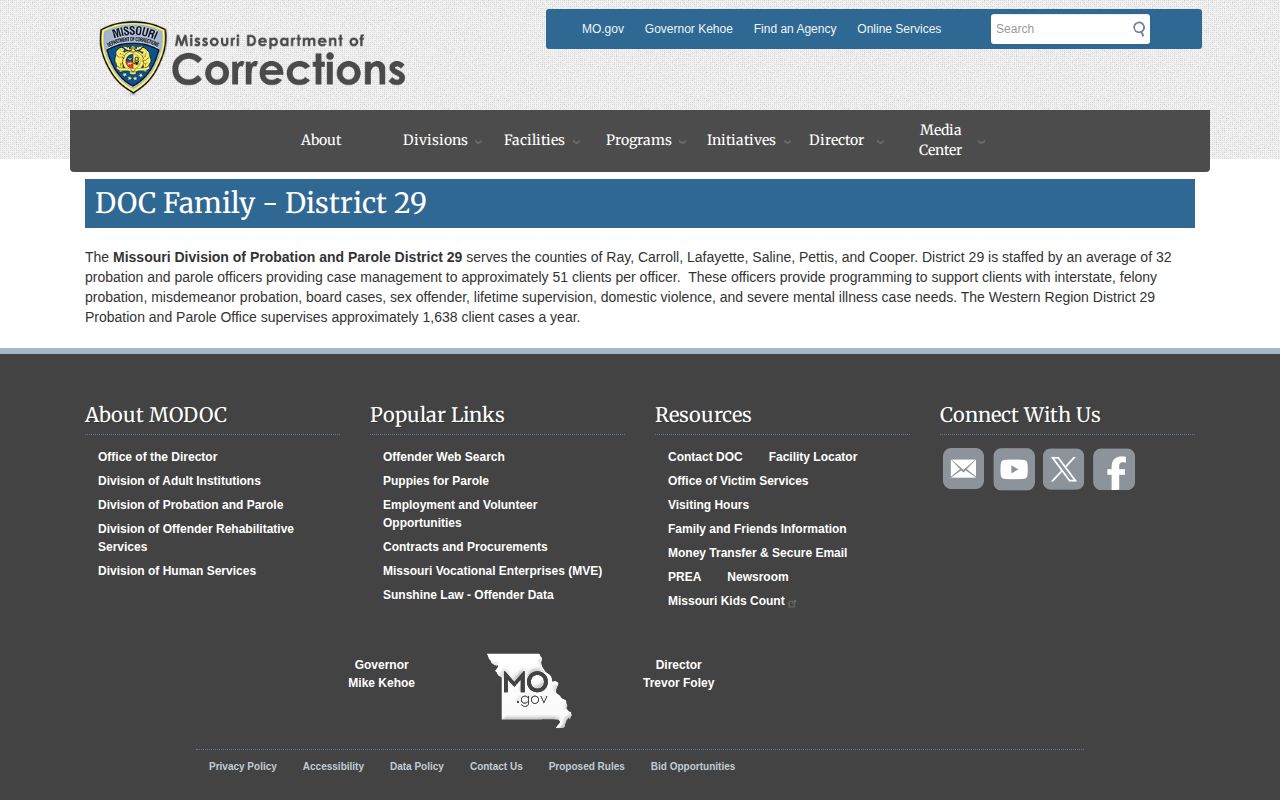
The image should be used to confirm the district identity and stated coverage, while an individual assignment still requires a direct record check.
Saline County Post-Release Office
The District 29S Marshall satellite is the most useful local contact when MODOC assigns a person there. Family-and-friends guidance says public confirmation can include whether a person is under supervision, the supervising officer and office location, custody or bond status, a parole or conditional-release date, a Parole Board decision, and the county of conviction or sentence, subject to information limits. Staff may withhold protected case details.
District 29S Marshall Satellite
1239 Santa Fe Trail, Suite 300
Marshall, MO
660-831-5238
Call with an accurate name and DOC number, then ask what may be confirmed as public information. The office is not a source for a full confidential case file. MODOC offices may screen visitors and prohibit weapons. Follow staff direction before visiting. A person sentenced in Saline County may report elsewhere if an approved residence or later assignment places the case in another district.
Saline County Parole Hearing Decisions
The Missouri Parole Board decides parole matters. Its rules and Blue Book appendices provide time-to-serve and hearing-schedule guidance, but guideline ranges do not guarantee release. Hearing timing depends on sentence length. The Board can set a future release date, deny parole and schedule another hearing, or take other action allowed by its rules. A hearing alone is not a release event.
MODOC says a decision normally takes about eight to twelve weeks after a hearing. The Board reviews institutional conduct, adjustment, completed and needed programs, the release plan, and other case factors. Another hearing may be set one to five years later. Missouri does not publish a simple county-by-county calendar of named parole candidates or a general searchable decision database on the reviewed pages. Individual notices and MOVANS events are the practical channels.
The Missouri Parole Board page gathers the Board rules and release-guideline links.
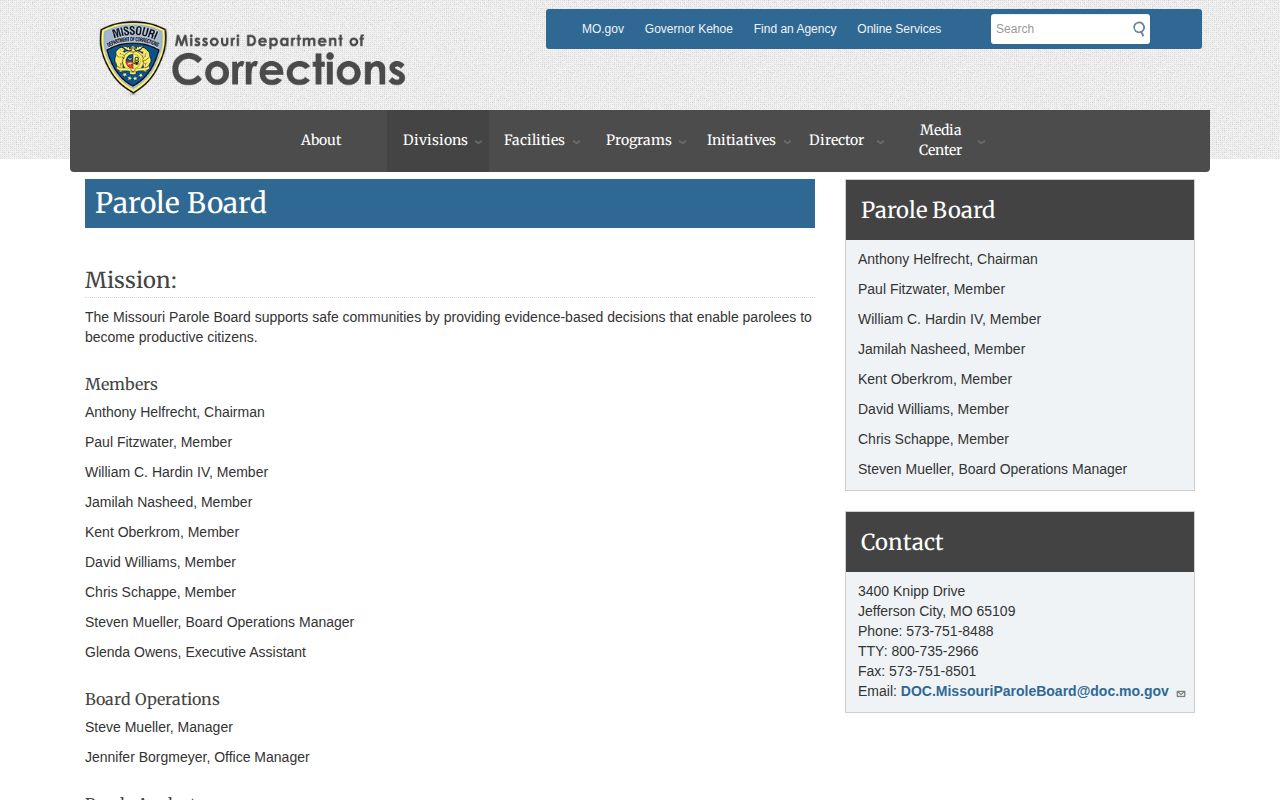
The Board material helps interpret the process, but only the decision notice and current MODOC record establish the action in a specific case.
Saline County Supervision Violations
Supervision conditions vary by judgment, release certificate, and case plan. At a high level, a person may have reporting duties, residence or travel limits, program requirements, or other lawful directions. An alleged violation is not a new conviction. The supervising agency and court or Board decide the next formal step. A detainer or warrant can also keep a person in custody after another case appears ready for release.
An absconder is alleged to have stopped complying or to be missing from supervision. Do not approach or try to detain that person. Confirm active legal status through the responsible agency and public court record. MOVANS can send custody-change events for a matched person, but an alert is a prompt to check the originating authority, not a certified warrant record.
Saline County Supervision Warrant Limits
Saline County has a distinctive local restriction. The Sheriff's official warrant page says active-warrant information is not provided by phone. It directs a person who believes a warrant exists to come to the Sheriff's Office and ask. After an arrest, bond questions go to the jail. This policy means a phone call that yields no warrant information is not a clearance, and disappearance from a roster is not proof that a warrant has ended.
For a supervision issue, start with the assigned probation and parole office. Review Case.net for public docket events, and follow the Sheriff's stated warrant procedure if that question remains. Separate the records: the court documents legal orders, the Sheriff handles a county warrant or booking, and MODOC documents field supervision. Each can hold a different part of the current picture.
Note: Never rely on a copied or stale web entry to decide whether a Saline County warrant remains active.
Ending Saline County Supervision
Supervision can end through lawful discharge, expiration of the controlling term, court action on probation, or another authorized agency action. Missouri section 217.703 permits eligible people to earn thirty days of compliance credit for each full calendar month of compliance. Absconders do not earn the credit. MODOC calculates it at least twice each year, and notice comes before final discharge. Eligibility limits and statutory exclusions still apply.
Earned compliance credit affects eligible community supervision. It is not a credit that changes the original prison exit date. Likewise, release from the Saline County Detention Center does not prove that probation or parole ended. The Saline County released-inmate search and records coverage can establish the county custody event, while MODOC and the court establish the later supervision result. Full discharge also does not erase the historic conviction or booking. Expungement and record closure are separate legal processes.
When the active search no longer returns a person, request the public completed and discharge fields from MODOC or obtain the relevant court entry when possible. Keep the DOC number, exact status language, responsible office, and effective date together. That record set is far stronger than a bare claim that someone is simply "off parole."